
Understanding the ARPIA User View
🔍 Understanding the ARPIA User View
The Home Screen of your WorkArea opens automatically when you sign in. It gives you an at-a-glance status of your WorkArea and acts as the launch point for the tools you use most.
What you see depends on your Security Profile. Everything on this screen — counters, tools, and navigation — is scoped to the WorkArea you are currently in and to the Security Profile assigned to your account by your WorkArea Admin. Two users in the same WorkArea may see different counts and tools. If something you expect isn't visible, contact your WorkArea Admin to review your profile permissions.
📖 Admins: see Security Profiles and How to create a Security Profile.
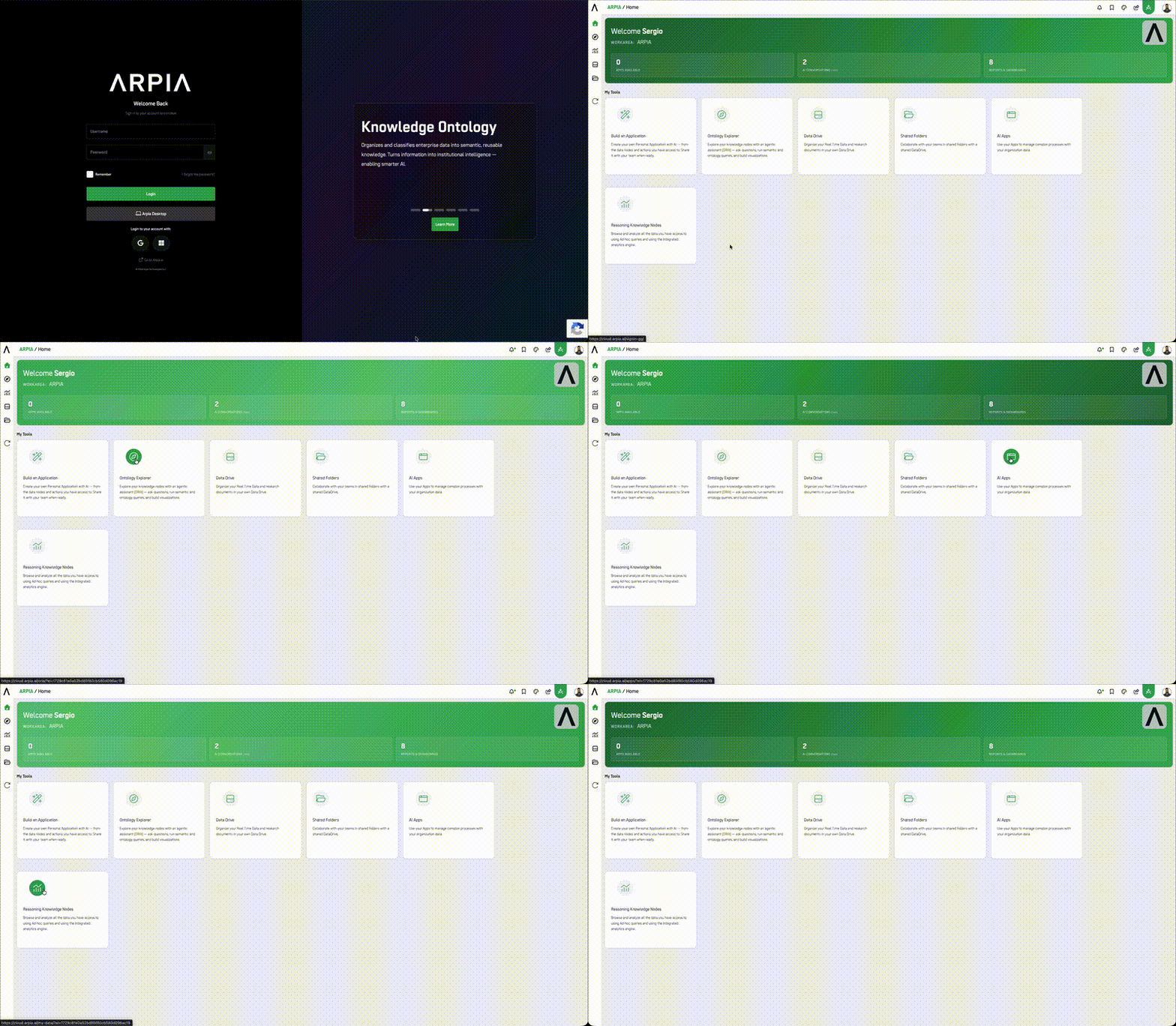
The page is organized into four key sections.
1. Header
The header runs across the top of every page and provides quick access to notifications, tips, sharing, and your account.

📖 See Header Tools for a full breakdown of each element.
2. Welcome Banner
The Welcome Banner displays your name and current WorkArea, and includes three live counters that summarize the current state of your WorkArea at your Security Profile's access level:
- Apps Available — AI Apps your Security Profile grants you access to
- AI Conversations — your AI conversation usage, shown against your allotment (e.g.
2 (300)means 2 used of 300 allowed) - Reports & Dashboards — Dashboards your Security Profile grants you access to

** — crop of the Welcome Banner showing the three status counters from a WorkArea with non-zero values.
A value of
0is expected in two situations: the WorkArea is new and nothing has been created yet, or your Security Profile has not been granted access to that resource type. If you expect a non-zero count, contact your WorkArea Admin to verify your profile permissions.
3. Main Menu
The Main Menu (left navigation rail) is persistent across the WorkArea and varies based on your Security Profile. It lets you move between sections without returning to Home, and can appear collapsed (icons only) or expanded (icons with labels). Typical destinations include:
- Home — this landing page
- Insights — reporting and analytics
- DataDrive — your personal data storage
- Shared Folders — team-shared folders
- Refresh — reloads the current WorkArea context (an action in the rail, not a navigation destination)
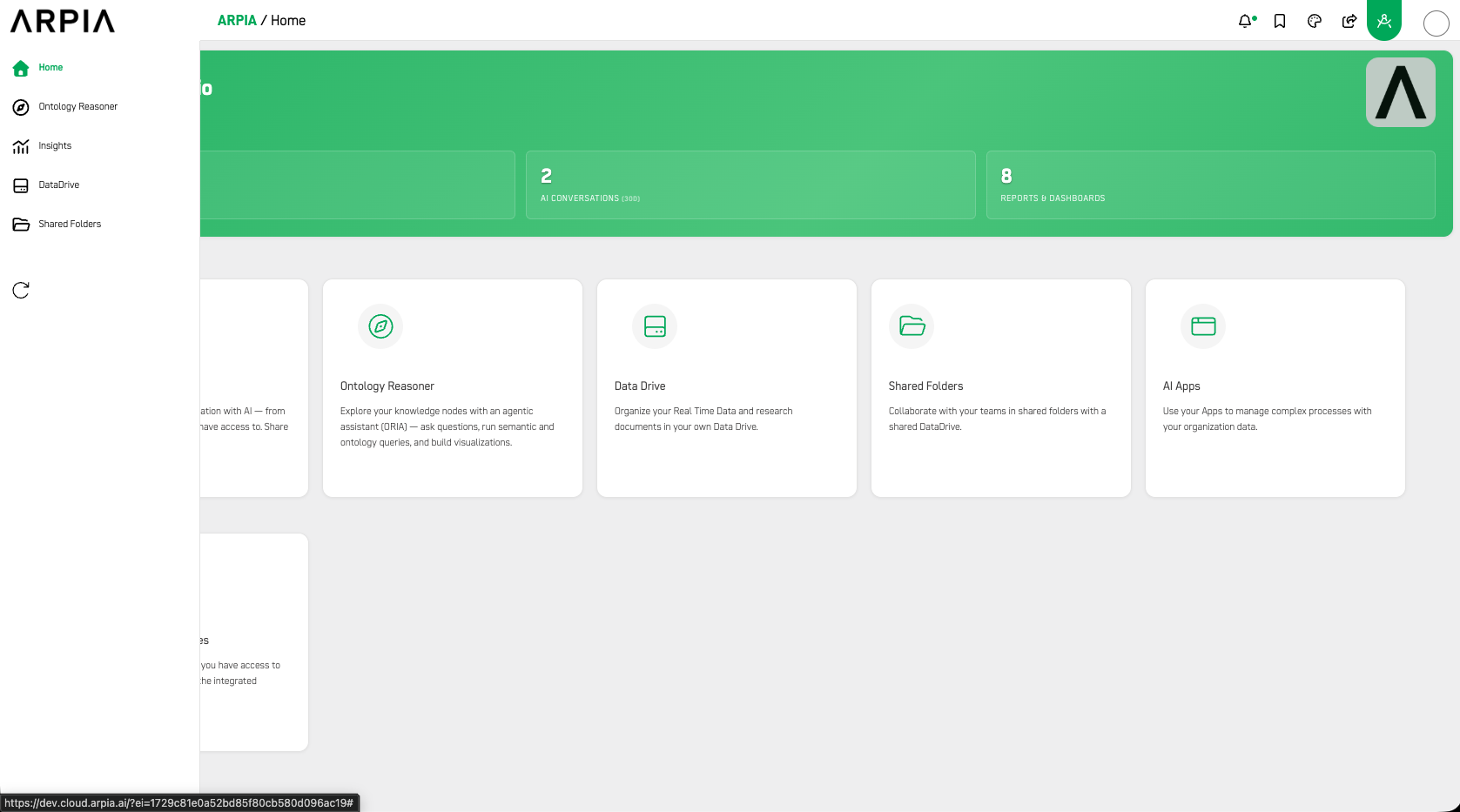
** — side-by-side or annotated capture of the navigation rail in both expanded and collapsed states.
4. My Tools
This section features the core working surfaces that launch directly from the Home Screen:
- Build an Application — create your own Personal Application with AI, from the data nodes and actions you have access to; share it with your team when ready
- Ontology Reasoner — explore your knowledge nodes with an agentic assistant (ORIA) — ask questions, run semantic and ontology queries, and build visualizations
- Data Drive — organize your Real Time Data and research documents in your own Data Drive
- Shared Folders — collaborate with your teams in shared folders with a shared DataDrive
- AI Apps — use your Apps to manage complex processes with your organization data
- Reasoning Knowledge Nodes — browse and analyze all the data you have access to using ad-hoc queries and the integrated analytics engine
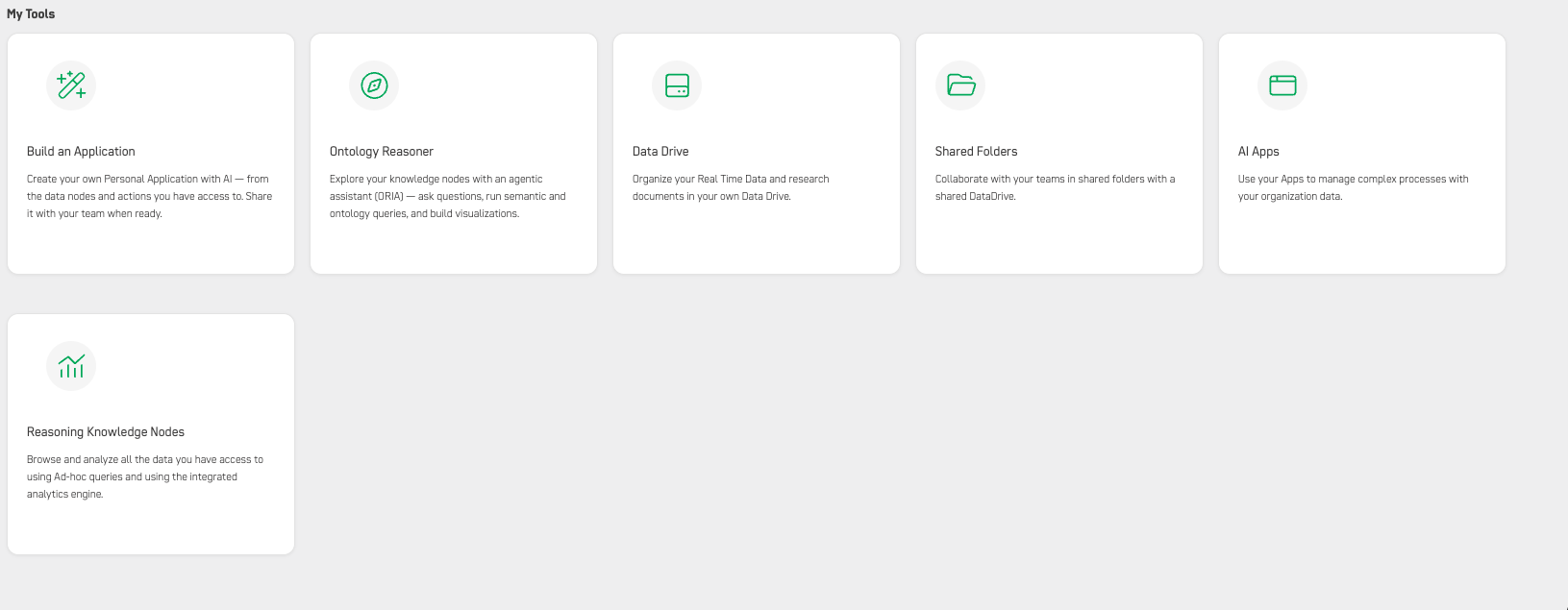
** — capture of the My Tools grid from a Superuser account so all five tiles are visible.
Important: Build an Application, AI Apps, and Reasoning Knowledge Nodes launch from the Home Screen, not the Main Menu. If you navigate away and can't find them, return to Home to access them.
Security Profiles and Access
ARPIA uses Security Profiles to control what each user can see and do within a WorkArea. A Security Profile defines access across four dimensions:
- AI Apps — which applications are available, down to individual screens
- Dashboards — which reports and dashboards are visible
- Reasoning Knowledge Nodes — which data nodes can be queried
- Administrative Settings — which platform management functions are enabled
Security Profiles are created and assigned by your WorkArea Admin via the AI Orchestrator. The user who creates a WorkArea receives a Superuser profile with full access to all resources by default. All other users are assigned a profile scoped to their role or department.
Your Security Profile is set at account creation and is not visible or editable by end users. If your access doesn't match your expectations, contact your WorkArea Admin.
| Who | Profile at login |
|---|---|
| WorkArea Creator | Superuser — full access to all resources |
| All other users | Department/role profile — scoped by WorkArea Admin |
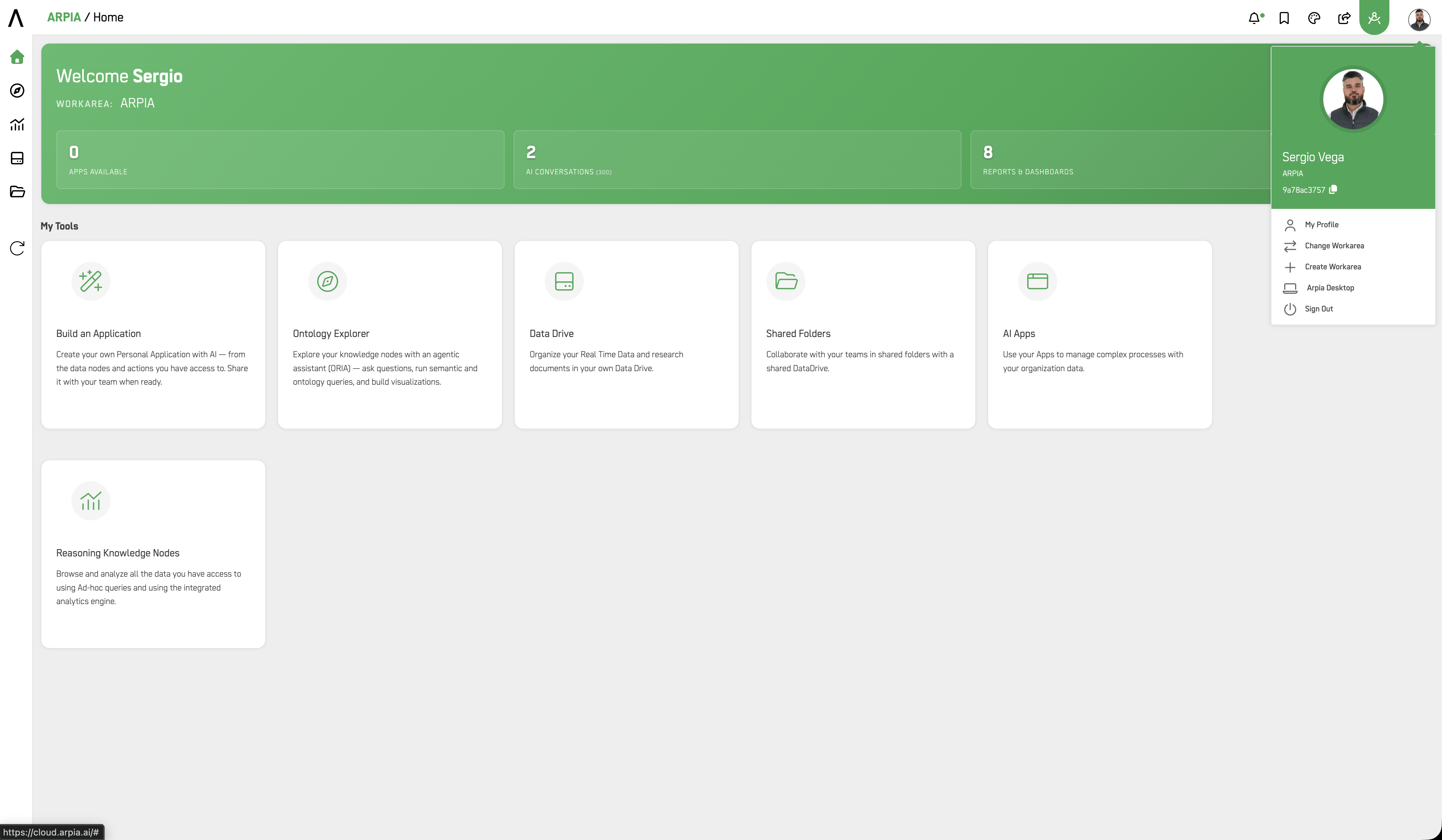
** — the EDIT PERMISSIONS panel from the Security Profile section of the Orchestrator, showing at least two of the four permission dimensions (Dashboards, DataApps, Administrative Settings, Reasoning Knowledge).
📖 For admins:
Updated 3 months ago